Will the White House AI Action Plan lead to Acceleration of AI Democratization?
The White House's "Winning the AI Race: America's AI Action Plan," [link] unveiled on July 23rd, 2025, is more than a policy document; it is a foundational strategic framework impacting the future competitive landscape of Artificial Intelligence. This plan, encompassing over 90 federal policy actions across innovation, infrastructure, and international leadership, presents both significant strategic opportunities and material risks that demand immediate attention and proactive leadership from business executives and professionals.
For executives and professionals, understanding this plan through the lens of the "Transformation Arc", a framework for anticipating and steering industry evolution caused by a general purpose technology is vital in evaluating professionals and organizational priorities in the AI Era.
The Transformation Arc: A Strategic Lens
The transformation arc is a conceptual framework I developed to capture the stages of adoption and societal impact of a general purpose technology (GPT) e.g., electricity, transportation, and now AI. To strategically position your organization, it's essential to recognize AI's current trajectory. Drawing parallels with past GPTs, we are currently ~20-25 years into the exploitative phase. Here, AI's immense power is heavily concentrated among a few tech giants, leading to pressing concerns about data exploitation, algorithmic bias, resource centralization, knowledge monopolization, and job displacement anxieties. (For a deeper dive, my July essay further explores this concept [link]).
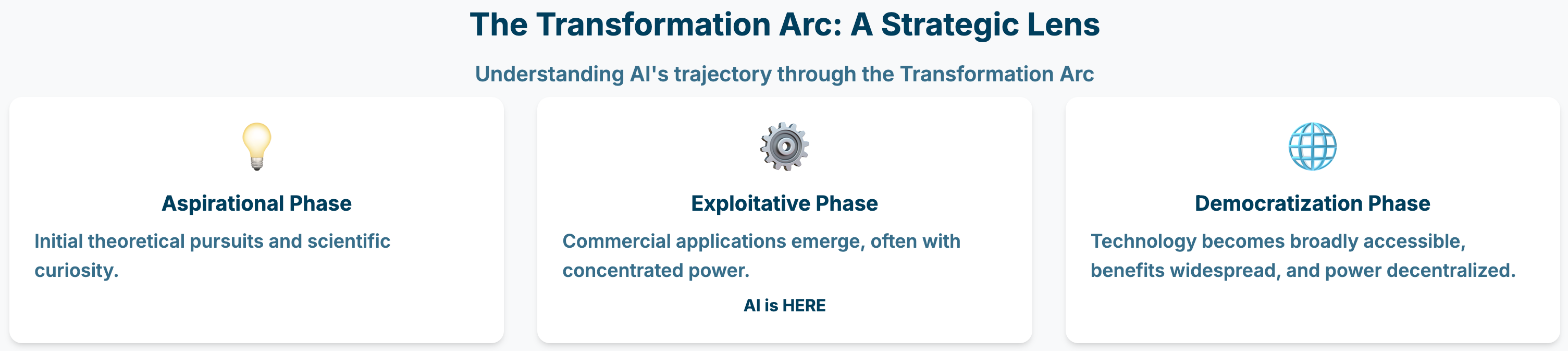
The Transformation Arc framework was inspired by Carlota Perez's Technological Revolutions and Techno-Economic Paradigms1. Perez describes long cycles of technological revolutions, often characterized by an "installation period" where new technologies emerge, followed by financial speculation that often leads to bubbles. This then transitions to a "deployment period" where the technology becomes widely adopted, driving real economic growth and ultimately resulting in a new way of life.
The urgent future imperative is the democratization phase. This phase demands that AI's benefits are broadly accessible, its development is ethically grounded, and its power is decentralized. This is the only way to achieve real and sustained economic and societal growth and innovation.
My July essay outlined these four focus areas: fostering open access and open-source models, establishing robust ethical governance frameworks, promoting AI literacy, and encouraging decentralized AI development. These steps are essential to mitigate data exploitation and knowledge silos, combat algorithmic bias, ensure accountability, and effectively guide workforce transformation.
Advancing AI literacy, safety, and workforce transformation requires companies and executives to invite diverse, domain-specific expertise. This approach ensures AI solutions drive real business value across their entire organization and lead to rapid adaptation, reskilling, and upskilling of the entire workforce.
With that context, the main question I explore in this article is how the White House AI Action Plan aligns with or diverges from the acceleration towards AI democratization?
But first a quick recap of the twenty-three pages long America’s AI Action Plan. America’s AI Action Plan frames pursuit of AI leadership as a critical national security imperative. The nation that pioneers the AI frontier will set global standards, reaping profound economic and military advantages. This plan is a whole-of-government strategy for the United States to win this race.
It includes a three-pillar strategy: Accelerate AI Innovation, Build American AI Infrastructure, Lead in International Diplomacy.
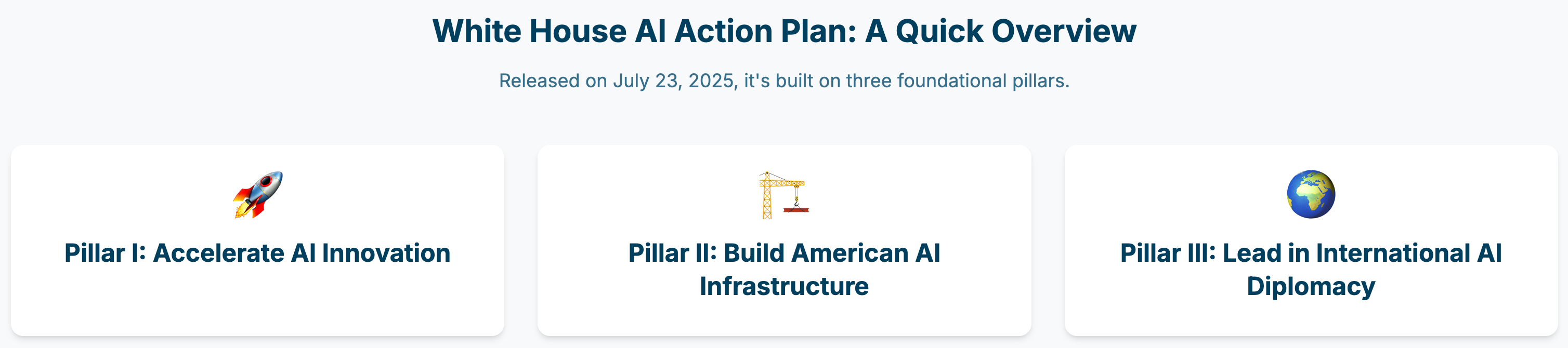
Pillar I: Accelerate AI Innovation
This pillar focuses on cultivating an environment within the United States that fosters rapid AI development and widespread application. The core objective is to ensure America possesses "the most powerful AI systems in the world" and leads in their "creative and transformative application" across all sectors. The Federal government's role is defined as creating optimal conditions for private-sector-led innovation to flourish, primarily by removing regulatory barriers and promoting American values in AI systems.
Pillar II: Build American AI Infrastructure
This pillar addresses the fundamental requirement for robust AI infrastructure and the energy resources necessary to power it. The plan explicitly states that AI represents "the first digital service in modern life that challenges America to build vastly greater energy generation than we have today." This means focusing on streamlined permitting for data centers, semiconductor manufacturing facilities, and energy infrastructure, while guaranteeing security and developing an electric grid to match the pace of AI innovation.
Pillar III: Lead in International Diplomacy and Security
This pillar outlines the strategy for extending America's AI leadership globally and preventing adversaries from misusing U.S. innovations. The premise is that global AI competition necessitates driving adoption of American AI systems, computing hardware, and standards worldwide. This involves exporting the American AI technology stack to allies and partners, countering adversarial influence in international AI governance bodies, and strengthening AI compute export control enforcement.
The Plan’s Focus on Accelerating Innovation & Competitive Advantage Presents Strategic Opportunities for US firms and US based workforce
The plan offers clear advantages for forward-thinking organizations and their workforce:
Fueling Open Innovation: The explicit championing of open-source and open-weight AI models directly fosters a more vibrant ecosystem. For businesses, this translates into reduced R&D costs, increased access to advanced tooling, and a foundation for enhanced transparency, which can accelerate internal innovation cycles and talent acquisition.
AI-Ready Workforce Development: The focus on expanding AI literacy and assessing job impacts signals a commitment to preparing the American workforce. Proactive engagement with these initiatives can ensure organizations have access to skills and talent and are actively shaping workforce development for the AI era, mitigating future labor gaps and enhancing human-AI collaboration.
Building a Trust Infrastructure: The push for a national AI evaluation ecosystem, with NIST guidelines and testbeds, is critical for de-risking AI adoption. It provides a framework for verifiable transparency and accountability, essential for building customer trust and facilitating broader enterprise AI integration.
Enhanced Scientific & Data Access: Investments in scientific datasets and networks promise increased access to foundational AI resources. This can empower a firm’s internal research teams and enable smaller, agile business units to leverage cutting-edge AI, fostering decentralized innovation.
Critical Risks & Unaddressed Challenges: Potential for Entrenchment
Conversely, several aspects of the plan could exacerbate existing challenges or introduce new risks to organizations and their workforce:
Accelerated Infrastructure, Overlooked Costs: The aggressive push for deregulation and expedited permitting for data centers and energy infrastructure (potentially bypassing environmental reviews) risks creating a "scale-at-all-costs" environment. While boosting computational power, this could escalate long-term operational costs due to energy consumption and expose organizations to increased environmental, social, and governance (ESG) scrutiny.
Nationalistic AI Posture: The narrative of "winning the AI race" and the strategy of exporting "full-stack AI packages" prioritize national dominance. While beneficial for certain sectors, this approach could limit global collaboration on AI governance, fragment international standards, and potentially expose U.S. businesses to retaliatory measures or restricted market access in key international territories.
Bias & Censorship Concerns in AI Development: The directive regarding "objective and free from top-down ideological bias" in federal AI procurement raises concerns about potential censorship or a narrowing of AI's diverse developmental pathways. If misinterpreted or broadly applied, this could stifle innovation in addressing real-world societal biases in AI, leading to less robust or ethically compromised solutions that carry significant reputational risk.
Ambiguous Workforce Transition Strategy: Despite acknowledging workforce needs, the plan lacks concrete, comprehensive provisions for large-scale retraining and social safety nets. This places a greater burden on individuals organizations to manage AI-driven job displacement and reskilling, potentially leading to increased labor costs, talent shortages in new AI roles, and heightened employee unrest.
Uncertain Regulatory Landscape: The exploration of federal intervention against state-level AI regulations creates an unpredictable regulatory environment. This fragmented approach could lead to compliance complexities for organizations operating across multiple states, hindering consistent AI deployment strategies and increasing legal overhead.
Unaddressed Copyright & IP Implications: A significant oversight in the plan is the lack of specific, comprehensive provisions addressing copyright and intellectual property (IP) laws for the AI era. The current "exploitative" phase thrives on the ambiguity surrounding AI models trained on copyrighted works without clear consent or fair compensation, and the unresolved question of ownership for AI-generated content. Without robust legal frameworks, this critical gap poses material risks to creative industries, breeds legal disputes, and could stifle innovation by disincentivizing content creation if fair value capture is undermined. This unaddressed area represents a substantial legal and competitive risk that could disrupt existing business models based on intellectual property.
The Path Forward: A Call for Proactive Leadership
The White House AI Action Plan marks a pivotal moment, but to realize AI's true democratized potential and secure the future of our workforce and organizations, much more is needed. Companies won't become forward-thinking by simply capitalizing on technological innovations and infrastructure investments; they need a strategy that builds on strengths and carefully prioritizes gaps in the AI Action Plan.
For example, if open-source solutions reduce your R&D costs, consider redirecting that investment. You can prioritize areas like energy-efficient AI infrastructure, workforce re-skilling, responsible AI, AI literacy, or IP protection advocacy, depending on the most pressing hurdle in your industry.
Below are five recommended priorities for professionals at all levels. Start with one or two for immediate action and revisit these frequently as the AI space evolves. Without combining technical advancements with strategic investment and prioritization, companies and professionals are unlikely to realize significant gains in efficiency, and productivity, or from new commercially viable AI capabilities.
Invest in Sustainable AI Infrastructure: Prioritize energy-efficient data center solutions and explore renewable energy procurement. This will not only mitigate escalating operational costs but also bolster your organization's ESG (Environmental, Social, and Governance) standing.
Champion Workforce Transformation: Lead by defining tailored human-AI collaboration strategies specific to your domain. Understand precisely where AI agents can enhance productivity without sacrificing the irreplaceable human elements of privacy, nuance, and judgment. This isn't just a technological upgrade; it's a crucial investment in your people.
Advocate for Clear IP & Copyright Frameworks: Actively engage with policymakers and industry bodies to push for precise regulations concerning AI training data and the ownership of AI-generated content. Concurrently, proactively establish robust internal IP policies to mitigate legal exposure and protect your creative assets.
Embed Responsible AI Practices: Mandate the development and implementation of robust ethical guidelines, transparency protocols, and accountability mechanisms across all AI initiatives within your organization. This transcends mere compliance; it's a strategic imperative for building brand trust and effective risk mitigation.
Drive AI Literacy & Continuous Learning: Champion company-wide AI education programs to empower the entire workforce. Foster critical engagement with AI tools and ensure your organization is equipped to adapt processes, systems, and human skillsets for the evolving demands of the AI era.
Proactive leadership at all levels in these critical areas will not only help businesses and professionals navigate the complexities of the current AI landscape but will also define their organization's resilience, ethical standing, future-ready workforce, and competitive advantage in the decades to come. Ultimately, C-level active championship and sponsorship is crucial for successful acceleration towards our collective democratized AI future.
The AI Action Plan is a fairly comprehensive document that is worth taking the time to understand and unpack. To supplement this article I have created a visual summary of this article that includes a quick recaps of the key policy action points across the three pillars of the White House AI Action Plan that can be viewed at kairoses.com/#visualsummary
About the author: I am an AI executive and strategist with over 25 years of experience scaling and delivering AI value at Fortune 50 firms. My company, Kai Roses, is built on three core pillars:
AI Consulting: Guiding businesses to transform and develop strategies for the AI era.
AI Product: Building essential creator tools that empower creators to own, monetize, and preserve their assets on their own terms.
AI Foundation: Evangelizing for AI literacy and responsible implementation. I do this through my monthly Substack, as a Senior Industry Fellow at the UC Irvine Center for Digital Transformation, and as a Global Distinguished Fellow at AI2030.