Will the White House AI Action Plan lead to Acceleration of AI Democratization?
The White House's "Winning the AI Race: America's AI Action Plan," [link] unveiled on July 23rd, 2025, is more than a policy document; it is a foundational strategic framework impacting the future competitive landscape of Artificial Intelligence. This plan, encompassing over 90 federal policy actions across innovation, infrastructure, and international leadership, presents both significant strategic opportunities and material risks that demand immediate attention and proactive leadership from business executives and professionals.
For executives and professionals, understanding this plan through the lens of the "Transformation Arc", a framework for anticipating and steering industry evolution caused by a general purpose technology is vital in evaluating professionals and organizational priorities in the AI Era.
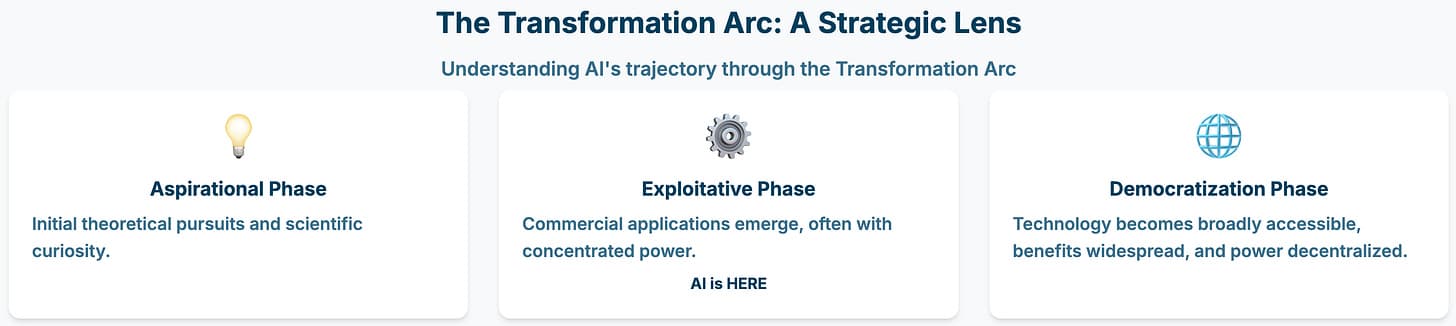
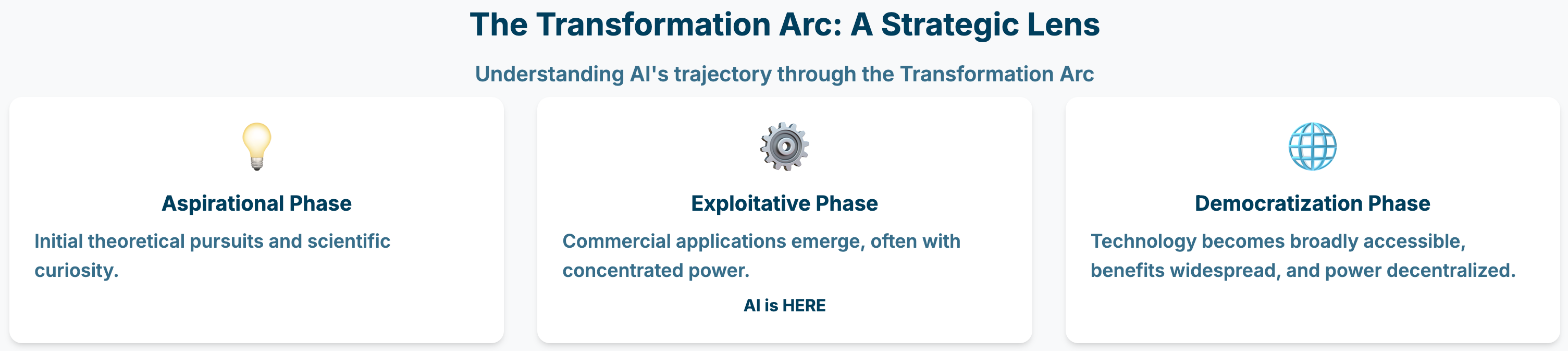
The Transformation Arc: A Strategic Lens
The transformation arc is a conceptual framework I developed to capture the stages of adoption and societal impact of a general purpose technology (GPT) e.g., electricity, transportation, and now AI. To strategically position your organization, it's essential to recognize AI's current trajectory. Drawing parallels with past GPTs, we are currently ~20-25 years into the exploitative phase. Here, AI's immense power is heavily concentrated among a few tech giants, leading to pressing concerns about data exploitation, algorithmic bias, resource centralization, knowledge monopolization, and job displacement anxieties. (For a deeper dive, my July essay further explores this concept [link]).
The Transformation Arc framework was inspired by Carlota Perez's Technological Revolutions and Techno-Economic Paradigms1. Perez describes long cycles of technological revolutions, often characterized by an "installation period" where new technologies emerge, followed by financial speculation that often leads to bubbles. This then transitions to a "deployment period" where the technology becomes widely adopted, driving real economic growth and ultimately resulting in a new way of life.
The urgent future imperative is the democratization phase. This phase demands that AI's benefits are broadly accessible, its development is ethically grounded, and its power is decentralized. This is the only way to achieve real and sustained economic and societal growth and innovation.
My July essay outlined these four focus areas: fostering open access and open-source models, establishing robust ethical governance frameworks, promoting AI literacy, and encouraging decentralized AI development. These steps are essential to mitigate data exploitation and knowledge silos, combat algorithmic bias, ensure accountability, and effectively guide workforce transformation.
Advancing AI literacy, safety, and workforce transformation requires companies and executives to invite diverse, domain-specific expertise. This approach ensures AI solutions drive real business value across their entire organization and lead to rapid adaptation, reskilling, and upskilling of the entire workforce.
With that context, the main question I explore in this article is how the White House AI Action Plan aligns with or diverges from the acceleration towards AI democratization?
But first a quick recap of the twenty-three pages long America’s AI Action Plan. America’s AI Action Plan frames pursuit of AI leadership as a critical national security imperative. The nation that pioneers the AI frontier will set global standards, reaping profound economic and military advantages. This plan is a whole-of-government strategy for the United States to win this race.
It includes a three-pillar strategy: Accelerate AI Innovation, Build American AI Infrastructure, Lead in International Diplomacy.