2025: The Year of Colliding Realities
For years, we treated the future of AI as a linear path, a steady climb toward efficiency and intelligence interspersed with some long, cold winters.
As we close out 2025, we’ve discovered that reality is far more fractured. We lived through a year of colliding realities, where two diametrically opposed truths can exist at the same time.
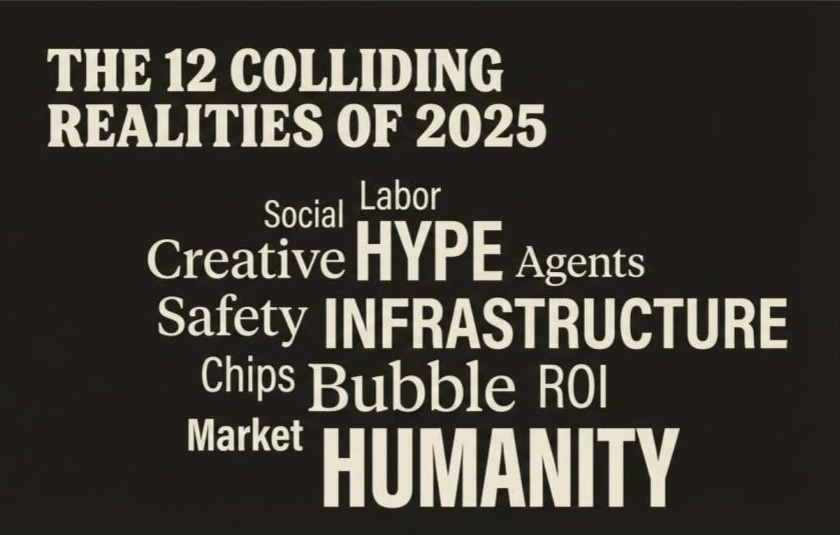
In 2025, the truth depended entirely on where you sat in the ecosystem. Here are the 12 colliding realities that defined our year:
Hype: AI is fundamentally over-hyped vs. AI is the most transformative technology of our time.
Labor: Jobs are disappearing due to AI automation vs. Jobs are disappearing because of cost cutting, bloat correction and job recomposition.
Social: Young people are wary of fake AI interactions vs. Young people are comfortable talking to bots over humans for advice.
Creative: AI is a force multiplier for creators vs. AI is a vacuum stealing human work and reducing original creativity.
Safety: Guardrails are an innovation tax vs. Guardrails are the only path to mass enterprise adoption.
Agents: Agents are effective at task-level automation vs. Agent integrations are crashing legacy operations.
Infrastructure: Data center investment is becoming unsustainable vs. Current investment levels are still nowhere near enough to meet global compute demand.
Chips: We have a critical GPU shortage to build AGI vs. We are over investing in silicon without a clear long-term amortization value.
Bubble: Circular investments are unsustainable vs. Cross-industry participation is the only way to drive systemic economic growth.
ROI: Legacy enterprises are failing to see value in AI pilots vs. AI-first companies are growing at double-digit rates.
Market: AI startups are reaching billion dollar valuation at record speed vs. Market consolidation has already begun.
Humanity: AI will be the end of humanity vs. AI will be the savior of humanity.
The 2025 labor market was defined by a jarring irony. While headlines blamed AI for job losses, a closer look at the data revealed other motives. Software teams that tripled in size during the digital acceleration are being right-sized. Companies thinking through cost cutting, bloat correction and job recomposition executed mass layoffs; 1.2 million jobs were lost in the US, 54% higher than in 2024 with tech, retail, telco, and government being the hardest hit sectors. In this context, AI has evolved from a tool that can be bought and plugged in into a core organizational competency that requires rethinking organizations and job functions; it is the engine that empowers restructured, agile teams to lead the transition rather than just endure it.
On one hand, we saw Agentic AI gain acceptance for task-level automation, on the other, agents caused havoc within legacy software systems. This is because our pre-compute infrastructure was designed strictly for deterministic actions, not for the real-time self-learning and autonomous correction required by AI. Essentially we have the digital brain power, but our digital nervous systems - our legacy workflows, are rejecting the transplant.
Similarly, we saw a massive Power Paradox. While the industry screamed about a GPU shortage to reach AGI, the reality on the ground was that warehouses of chips sat idle because local power grids simply could not plug them in. We have hit the thermodynamic limit of how much heat we can pull off a piece of silicon before it melts. To go faster, we don't just need better math; we need better materials science.
Economically, the AI Bubble narrative collided with the AI Native reality. While legacy enterprises struggled to find ROI in their initial pilots, AI-First companies hit revenue milestones that previously took a decade to reach. We aren’t seeing a failure of the technology; we are seeing a failure of the legacy business model to adapt to it.
We are also witnessing a historic market compression: the fastest pace of startups reaching billion-dollar valuations in history, occurring simultaneously with massive market consolidation. I don’t recall another year where this volume of valuation growth and strategic acquisition (or the acqui-hire of entire founding teams) occurred in the same twelve-month window. It is a dual-track market where the winners are scaling at light speed, and the incumbents are aggressively buying their way into the future.
If you felt caught between the Hype and the Havoc of 2025, you are not alone. The transformation required is no longer a five-year roadmap, which explains why major consulting firms are currently undergoing their own massive pivots.
In 2026, we must consider a different form of transformation that mirrors evolution: where sensing and adapting are no longer mere initiatives, but the very fabric of our organizational culture. If AI requires active learning to address data and model drift in real-time, so too will our teams and organizations.
In my essay next month, I will share further insights into the specific archetypes of transformation I am seeing in the market across industries. For now, I leave you with one thought:
Future of transformation isn’t about picking a side; it is about the ability to understand these nuanced realities and build a path through them.
I wish you peace and perseverance this holiday season and in the new year. Cheers!
About the Author: Meghna Sinha is Chief AI Officer and Co-founder of Kai Roses, Inc. She specializes in developing business-aligned AI strategy.
Kai Roses was founded to incubate innovation and introduce springboard learning opportunities for young people. We are driven by challenges that create the greatest net positive impact on the world. Our product mission is focused on building essential tools for creators; our consulting and foundation pillars support the company’s growth and mission.
Thank you so much for reading my essay. If you found it insightful, please share, like, comment, subscribe.